
- HOME
- LATEST
- ABOUT GPC
- NEW HERE?
-
MINISTRIES
- Ministry Awareness: Opportunities to Serve
- Care Group
- Church Wide Bible Study (CWBS)
- Family Ministry
- Filipina Fellowship
- Indonesian Fellowship
- Mission Ministry
- Music Ministry
- Outreach Ministry
- Precept Bible Study Ministry
- School Ministry
- Senior Adults Fellowship (SAFE)
- Sunday School
- Women Ministry
- Youth and Young Adults Ministry
- RESOURCES
- CONTACT US
- GIVE
- 中文部
27.02.2026
The table was full of mandarin oranges and festive goodies, and in the middle of the usual New Year conversations, a couple began sharing about their new church journey. They had moved from a traditional church to a charismatic one for a few years. There was joy in their voices, something fresh and alive.
In one of their recent worship services, they shared how the church encouraged everyone to write down three prayers. The husband admitted he was reluctant at first. Still, he wrote three. One of them was reconciliation with his son. Their relationship had not been good for some time. There were distance, silence, and unspoken hurt. He wrote that prayer without much expectation.
That evening after he wrote that prayer, his phone rang. It was his son. The son broke the ice. The tone was different. Something softened. Since that day, they have slowly rebuilt their relationship. The bridge that seemed broken began to mend. As they shared, I could sense their wonder. God answered his prayer quickly, tangibly and almost dramatically.
The next morning, I reflected on the conversation with my daughter, who had been present. I said to her, “We Presbyterians don’t often share answered prayers like that. We do, but not as frequently or as vividly. Our charismatic brothers and sisters seem so free to testify about God’s blessings in concrete ways.”
My daughter said something sharp and thoughtful, “But I heard more about how good the church was. I didn’t hear much about Jesus.”
Her words stayed with me.
It is possible for testimonies to shift attention subtly. The focus can move from Christ to the church, from the Giver to the gift. People may walk away impressed by the experience rather than drawn to the Savior.
Yet on the other hand, we who belong to more traditional churches may be too cautious. We guard doctrine carefully. We preach expositionally. We avoid emotional exaggeration. But perhaps we have become hesitant to speak personally about how God works in our lives. We affirm God’s sovereignty, but we rarely say, “Let me tell you what our Lord did.”
Then another question arose in my heart: We share answered prayers. But what about the unanswered ones? The child who has not returned, the illness that lingers, the conflict that has not softened… How do we testify about these?
Perhaps we testify by continuing to pray. Praying unceasingly in what seems like a hopeless situation is itself an act of hope. It declares that we trust God not because outcomes are immediate, but because His character is faithful. To keep praying is to say, “I still believe You are good.”
Answered prayers reveal God’s power. Unanswered prayers shape our surrender. They teach us to submit our lives to God but not to the tangible gifts of God. They loosen our grip on visible results and deepen our dependence on Him. Sometimes the greater miracle is not that circumstances change, but that our hearts are humbled.
So how do we share in a way that truly glorifies God? Not simply by adding at the end of our story, “All glory to God,” as a polite disclaimer.
We glorify God when we name Him clearly, “Our Lord was merciful.” We glorify Him when we confess our weakness, our doubt, our reluctance. We glorify Him when we point beyond the gift to the Giver. We glorify Him when we speak honestly of both the “yes” and the “not yet.”
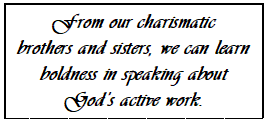
From our charismatic brothers and sisters, we can learn boldness in speaking about God’s active work. From our Reformed heritage, we can learn to anchor every testimony in Christ and His redemptive purposes.
Chinese New Year is a season of reunion. It is fitting that a story of reconciliation was shared around a festive table. Yet every reconciliation ultimately points beyond itself, to the God who reconciles sinners to Himself. If we dare to share our encounters with God, let it not be a showcase of our spirituality or our church’s vibrancy. When people walk away, may they not say, “What a great church,” but rather, “What a gracious Savior!”
Building His Missional Community,
Pastor Forest