
- HOME
- LATEST
- ABOUT GPC
- NEW HERE?
-
MINISTRIES
- Ministry Awareness: Opportunities to Serve
- Care Group
- Church Wide Bible Study (CWBS)
- Family Ministry
- Filipina Fellowship
- Indonesian Fellowship
- Mission Ministry
- Music Ministry
- Outreach Ministry
- Precept Bible Study Ministry
- School Ministry
- Senior Adults Fellowship (SAFE)
- Sunday School
- Women Ministry
- Youth and Young Adults Ministry
- RESOURCES
- CONTACT US
- GIVE
- 中文部
09.01.2026
During our Office Bearers’ Briefing last Sunday, I shared off script that we are always working against culture. As I reflected on that statement later, I realized it is true—but only in part. In a society that prizes busyness, efficiency, and constant rushing, it is easy to be swept along. To pause, to rest, to be still before God, these are deeply counter-cultural acts. They remind us that our worth is not measured by speed or productivity, but by grace. Sabbath, silence, and prayer quietly protest a culture that never stops.
Yet the gospel does more than simply resist culture. It also engages and transforms it.
I first wrestled with this tension seriously about fifteen years ago during my intercultural studies. There, I encountered the five well-known models of Christ and culture proposed by H. Richard Niebuhr: Christ against culture, of culture, above culture, in paradox with culture, and transforming culture. Each model offers valuable insight, yet does not fully capture the complex missionary reality we face today, especially in a pluralistic, fast-changing society like ours.
This is where the voice of Lesslie Newbigin continues to shape my thinking. Having served many years as a missionary bishop in India, Newbigin saw clearly that the gospel is never merely one cultural option among many. It is public truth—a living Word that confronts, challenges, and reshapes every culture it enters. The church, therefore, is not only counter-cultural; it is trans-cultural: a community that embodies a reality beyond any single culture and bears witness to the coming kingdom of God.
This lies at the heart of Vision 2026: Building His Missional Community. We are not called to withdraw from the world, nor simply to react against it, but to live as a community so deeply formed by Christ that our shared life becomes a visible sign of God’s reign.
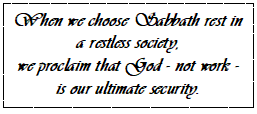
When we choose Sabbath rest in a restless society, we proclaim that God - not work -is our ultimate security. When we slow down to listen deeply to one another in a culture of noise and distraction, we reflect the attentiveness of Christ. When we grow together across generations, backgrounds, and differences, we resist the fragmentation of our world and embody the reconciling power of the gospel.
Vision 2026 calls us to build together, not merely as individuals pursuing private faith, but as a body being “joined and held together” under Christ our Head (Ephesians 4:16). As leaders equip, as every member serves, and as love becomes the atmosphere of our life together, the church matures, not by striving, but by abiding.
In this way, we live both against culture and beyond it. We participate in the trans-cultural reality of the gospel, a reality that lovingly judges every culture, yet also redeems and renews it. Our calling, then, is not simply to live differently, but to live faithfully as a missional community—quietly, patiently, and courageously bearing witness to God’s kingdom as it breaks into the world around us.
Building His Missional Community,
Pastor Forest
Notes:
H. Richard Niebuhr outlined in his book, Christ and Culture (1951) that Christians have imagined Christ against, of, above, in paradox with, and transforming culture.
Lesslie Newbigin, in Foolishness to the Greeks: The Gospel and Western Culture (1986), reframed this discussion b y insisting that the gospel is always a missionary encounter with culture — not only counter‑cultural but trans‑cultural, confronting and renewing every society as public truth.